
- FTSE 100 falls 70 points
- Currys drops after huge loss
- Ex-dividends add to decline
4.50pm: FTSE extends losses
The UK's main index finished well in the red at 7,426 points for a 0.9% loss on the day.
Markets tumbled as the Bank of England and ECB reiterate the troublesome year ahead, says Joshua Mahony, senior market analyst at online trading platform IG.
“The inflation-led rebound seen on Tuesday seems a distant memory today, with the S&P 500 slumping into a fresh five-week low in early trade. The collapse in equity valuations comes as traders face up to an impending economic collapse where central banks see to exacerbate rather than remedy the situation," Mahoney noted.
"Higher for longer is the message from the likes of the FOMC, BoE and ECB, with all concerns cast aside in a bid to combat elevated prices. The difficulty for the bulls is that this current outlook remains difficult to swallow despite the favourable backdrop of declining commodity prices.”
3.55pm: Markets remain under the cosh
Leading shares remain on the back foot as we head into the close, following the latest rate rise by the Bank of England and a decline on Wall Street.
The FTSE 100 is down 59.12 points or 0.79% at 7436.81, having earlier fallen to 7411.
A number of shares going ex-dividend is not helping matters, with DS Smith PLC (LSE:SMDS) down 4.11%, Burberry Group PLC (LSE:BRBY) losing 3.93%, and Associated British Foods PLC (LSE:ABF) falling 3.62%.
Meanwhile Ocado Group PLC (LSE:OCDO) continues on its volatile way, down 4.33%.
With the UK rate rise possibly not as high as it could be, property and housebuilding shares are among the risers.
Berkeley Group Holdings PLC (LSE:BKG) is 1.21% better, Barratt Developments PLC (LSE:BDEV) is up 1.04% and Taylor Wimpey PLC (LSE:TW.) has added 0.83%.
Land Securities Group PLC (LSE:LAND) has climbed 0.79%, helped by an upgrade from sell to neutral by Goldman Sachs (NYSE:GS).
3.07pm: Sterling remains under pressure
The pound meanwhile continues to decline.
It is down 0.92% against the dollar at US$1.2301 and has dropped 1.16% against the euro to €1.1496.
The Bank of England raised interest rates by 50 basis points as expected, as did the US Federal Reserve and the European Central Bank.
But both the latter made more hawkish noises about further rises than had been anticipated, which helps explain the downturn in sterling.
2.48pm: Bailey on rate rises and inflation
If you want to hear from the horse's mouth why the Bank of England raised interest rates, then here is just the thing for you:
Andrew Bailey explains why we have raised rates by 0.5% today. Inflation is too high, but we think it will fall back quite sharply from the middle of next year. Raising interest rates is the best way we have of making sure that happens. pic.twitter.com/6weWyFOO5Z
— Bank of England (@bankofengland) December 15, 2022
2.40pm: US markets miss out on any Santa rally
US stocks opened in the red as the Fed’s 50 basis point interest rate hike yesterday, along with the European Central Bank and Bank of England following with their own 50 basis point rate hikes this morning, weighed on investor sentiment.
Just after the market opened, the Dow Jones Industrial Average had shed 322 points or 1%, the S&P 500 had dipped 46 points or 1.1%, and the Nasdaq Composite had lost 165 points or 1.5% at 11,006 points.
Swissquote Bank senior analyst Ipek Ozkardeskaya said it was known that Fed chair Powell would not tell investors: “‘Ho ho ho, inflation is now 7%, we will stop tightening policy and hiking the rates. So, you can buy stocks, bonds, cryptocurrencies, meme stocks, whatever you find. Merry Xmas!”
“No, he was not going to do that, and he did not,” Ozkardeskaya said.
Ozkardeskaya said, in summary, that the FOMC message was clear: the Fed is not ready to stop hiking rates, even though they will be hiking by smaller chunks.
“Jerome Powell said yesterday that the last two CPI reports were ‘a welcome reduction in the monthly pace of inflation’, however, ‘it will take substantially more evidence to have confidence’ that the job is done,” she said.
“Crystal clear. No pause, no cut, no softening in sight.”
Meanwhile back in the UK, the FTSE 100 is currently down 55.65 points or 0.74% at 7440.28.
1.34pm: US jobless claims drop sharply
Over in the US, weekly jobless claims have come in well below forecasts, showing an unexpected fall.
The number of Americans seeking unemployment benefit for the first time last week was 211,000, down from the previous week's level of 231,000, itself revised up by 1,000.
Analysts had forecast a figure of 230,000.
The strength of the labour market is one of the key indicators the Federal Reserve considers when assessing its interest rate decisions.
US Weekly Jobless Claims - act: 211k, exp: 230k, prev: 230k
US Continuing Claims - act: 1671k, exp: 1674k, prev: 1671k
— Michael Hewson ???????? (@mhewson_CMC) December 15, 2022
1.24pm: ECB lifts rates and warns of more to come
The European Central Bank has also raised its interest rates by 50 basis points - just like the Fed and Bank of England - and said it expected to raise them significantly further.
It said inflation remained far too high - at 10% in November - and was projected to stay above target for too long.
"The Governing Council judges that interest rates will still have to rise significantly at a steady pace to reach levels that are sufficiently restrictive to ensure a timely return of inflation to the 2% medium-term target," it said.
We raised interest rates by 0.50 percentage points.
See our latest monetary policy decisions https://t.co/3VdGkL3X2w pic.twitter.com/tTTfr0Poqd
— European Central Bank (@ecb) December 15, 2022
The guidance appears to be more hawkish than anticipated, and the pound has lost further ground against the euro, down 0.63% at €1.1558.
???????? The ECB hikes rates by 50bp as expected, but gives *very* hawkish guidance, based on the "substantial upward revision" to inflation, noting that interest rates will still have to rise "significantly at a steady pace" to reach levels that are sufficiently restrictive. pic.twitter.com/uKT6PYsg85
— Frederik Ducrozet (@fwred) December 15, 2022
1.05pm: Rates to peak at 4.5%?
After today's rate rise to 3.5% analysts believe they may now peak at 4.5% next year.
Laith Khalaf, head of investment analysis at AJ Bell, said: "“It was notable that unlike last month, in its latest commentary the Bank didn’t choose to take issue with market expectations for future interest rates, which suggests these are now more in tune with what policymakers are thinking, namely a peak of around 4.5% next summer. Clearly there are lots of factors which can move the interest rate peak up or down, but for now 4.5% looks a reasonable working assumption.”
Susannah Streeter, senior investment and markets analyst at Hargreaves Lansdown, agreed: "The predicted peak in UK interest rates has fallen back now, coming in a few notches above 4.5% by August 2023. This is a reflection of faster than expected easing of inflation and the return of financial stability, with Jeremy Hunt becoming the new chancellor, after the volatility experienced in September."
12.57pm: Ninth rate rise in a row
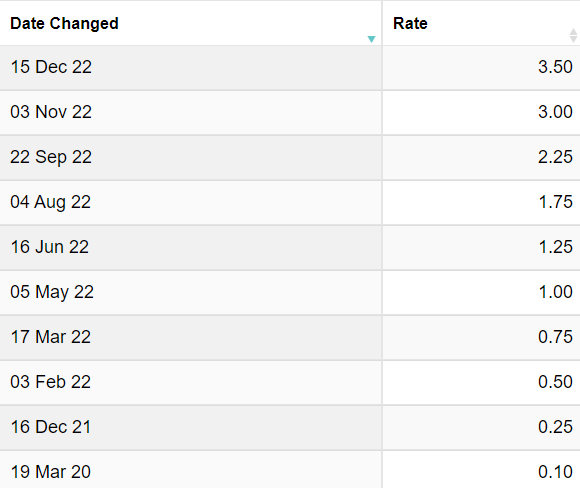
Today's rise is the ninth time the Bank of England has lifted interest rates.
It started a year ago at its December 2021 meeting, when rates were just 0.1% and it raised them to 0.25%.
But not everyone agrees this latest move was necessary, including the New Economics Foundation:
Higher interest rates will do little to tackle the main causes of inflation (the high prices of imported food and gas). But they will put a further squeeze on our economy which is already entering recession. 2/4
— NEF (@NEF) December 15, 2022
12.45pm: Volatilty ahead for markets after rate rise, say analysts
The pound and gilts are likely to come under further pressure in the months ahead, analysts believe.
Edward Hutchings, head of rates at Aviva Investors, said: "The Bank of England duly delivered on financial markets expectations of a 0.50% hike. With a 3-way split vote, it seems there is still much uncertainty amongst MPC members. However, the minutes state that the BoE do expect a recession for a ‘prolonged period’
"After its recent bullish run, sterling strength could be somewhat more questionable from here and with further Quantitative Tightening to come plus a staggering amount of gilt issuance, 2023 will continue to be volatile for the UK gilt market."
Meanwhile this latest rate rise will add to worries for mortgage holders.
Sarah Coles, senior personal finance analyst.at Hargreaves Lansdown, said: “[The rate rise is] going to come as a horrible blow for borrowers who got used to rock bottom rates, and haven’t seen anything like this for 14 years. To make matters worse, higher mortgage payments will come on top of all the other soaring costs – from food to fuel – and we have even more hikes looming on the horizon, with energy bills rising again in April...
"For savers, while we may well see easy access rates creep up as a result, for anyone with a branch-based easy access account from a high street giant, the rewards will be pitiful. Despite a year of rising rates, they’re still paying a fraction of 1%."
12.26pm: UK faces recession, says Bank, but perhaps a more shallow one
The Bank is still predicting a UK recession, but perhaps a more shallow one than it previously thought.
It says: "Bank staff now expect UK GDP to decline by 0.1% in 2022 Q4, 0.2 percentage points stronger than expected in the November Report. Household consumption remains weak and most housing market indicators have continued to soften. Surveys of investment intentions have also weakened further."
With a 0.2% fall in GDP in the third quarter, that would meet the technical definition of a recession.
12.23pm: Bank will be "forceful" on further changes if necessary
The Bank confirms the idea that more interest rate rises will be needed, and hints they could be hefty ones if required.
The minutes of this week's meeting say: "The labour market remains tight and there has been evidence of inflationary pressures in domestic prices and wages that could indicate greater persistence and thus justifies a further forceful monetary policy response.
"The majority of the Committee judges that, should the economy evolve broadly in line with the November Monetary Policy Report projections, further increases in Bank Rate may be required for a sustainable return of inflation to target.
"There are considerable uncertainties around the outlook. The Committee continues to judge that, if the outlook suggests more persistent inflationary pressures, it will respond forcefully, as necessary."
12.15pm: Sterling loses more ground on rate news
Leading shares remain in the red but have not reacted very much to the rate rise, which was very much in line with forecasts.
The FTSE 100 is currently down 34.05 points or 0.45% at 7461.88, having earlier fallen to 7428.
But the pound has lost more ground, down 0.86% against the dollar at US$1.2309 and 0.37% lower against the euro at €1.1588.
Naeem Aslam, chief market analyst at Avatrade, said: "Sterling is highly volatile after the Bank of England [decision]. The fact that BOE members are not on the same page with respect to the bank’s monetary policy has created more confusion for traders. With rates moving higher, the cost of living crisis is going to cripple further, and..would have a further adverse influence on the UK economy. This is another reason that sterling moved lower on the back of the bank’s decision."
12.08pm: Bank split three ways on rate decision.
The Bank's Monetary Policy Committee was split three ways on the interest rate decision.
Six voted for a 50 basis point rise, which won the day with the majority backing it.
Two members - Swati Dhingra and Silvana Tenreyro - wanted no change, but one - Catherine Mann - preferred to push through a 75 basis point rise.
⚠️ BoE raises rates by 50bps. But MPC is even more divided. 2 calls for no change (rate hikes done/pause). 1 for 75bps. Telling of where UK economy is - there's a case for 0 or 75bps. Nuts. Key thing next year is timing/depth of recession. One group on the MPC will be wrong$GBP pic.twitter.com/OEyee7gNb9
— Viraj Patel (@VPatelFX) December 15, 2022
12.00pm: UK rates lifted again
The Bank of England has raised UK interest rates by 50 basis points to 3.5% as expected.
The Bank has to juggle tackling rising inflation with making sure it avoids pushing the UK economy further into recession.
Despite inflation falling from a 41 year high of 11.1% to a better than forecast 10.7% in November, the Bank judged it could not avoid sanctioning another increase this time round.
The move means interest rates have hit a new 14 year high, following the 75 basis point increase in November.
Victoria Scholar, head of investment at interactive investor said: “This will immediately impact those on variable rate mortgages while those with fixed rate mortgages set to expire soon will have to refinance at higher rates."
The Monetary Policy Committee voted by a majority of 6-3 to increase #BankRate to 3.5%. https://t.co/sZoxu2CwyO pic.twitter.com/wvYhgDW1fg
— Bank of England (@bankofengland) December 15, 2022
11.45am: US markets set for opening fall
Wall Street is expected to open lower after the Federal Reserve maintained a hawkish stance after its last policy meeting of 2022 even as it curtailed its latest interest rate increase to 50 basis points after hiking by 75 basis points at its previous four meetings.
Futures for the Dow Jones Industrial Average fell 0.7% in Thursday pre-market trading, while those for the broader S&P 500 index declined 1.0% and contracts for the Nasdaq-100 shed 1.3%.
As well as raising rates to the highest level since 2007, Fed officials also indicated that they expect to maintain higher rates next year, with the first reduction only expected in 2024. The Fed’s “dot plot”, which tracks the expectations of individual members, suggested the terminal rate could be higher than expected and above 5%.
“Yesterday’s rate hike news from the Fed may have been as expected but given the underlying hawkish tone, equity traders were left rattled by the event,” commented James Hughes, chief market analyst at Scope Markets. “US indices lost ground in the wake of the announcement and as European trading gets underway, futures suggest a similar sized down-leg will be seen at Thursday’s opening bell.”
After trading higher for most of yesterday’s session, markets reversed course following the Fed announcement, with the Dow Jones ending trade 0.4% lower at 33,966, while the S&P 500 fell 0.6% to 3,995 and the Nasdaq Composite dipped 0.8% to 11,171.
“In light of the Federal Reserve’s hard-line stance it would perhaps be of little surprise if stronger than expected growth was seen in the November retail sales figures which are due for publication later, something which may be sufficient to claw back a degree of those losses picked up by equities,” Hughes added.
11.32am: Pound slips ahead of rate decision
The pound is heading lower ahead of the UK interest rate decision, mainly because of a recovery in the dollar after what was seen as a hawkish statement from the US Federal Reserve.
The Fed said "ongoing increases" in the key rate would be appropriate, dispelling suggestions that the rate hike programme could be ending soon.
Sterling is currently down 0.63% at US$1.2338. Against the euro it is also slightly down, off 0.05% at €1.1625.
10.40am: Goldman supports property companies
In a downbeat market, property companies are edging higher.
Land Securities Group PLC (LSE:LAND) is the leading riser in the FTSE 100, up 1.07% at 642.4p after analysts at Goldman Sach upgraded the business.
They raised their recommendation from sell to neutral and lifted their price target from 500p to 620p.
British Land Company PLC (LSE:BLND) is 0.57% better at 402.7p after Goldman kept its neutral rating but moved its price target from350p to 390p.
Overall though the FTSE 100 is still lower ahead of the Bank of England interest rate decision, down 40.35 points or 0.54% at 7455.58.
10.00am: Analysts bet on 50 basis point rise from Bank of England
With most analysts expecting the Bank of England to lift interest rates to 3.5%, it would be quite a shock if there is a different outcome.
UBS economist Anna Titareva says there are three reasons why a 50 basis point move from 3% is likely.
She said: "First, while there appears to be consensus in the [Bank's] Monetary Policy Committee that the labour market remains tight, several members have noted signs of an easing in labour demand, also reflected in the December labour market report.
"Second, medium-term inflation expectations, while remaining overall high, have eased in recent months.
"Third, given the lags in monetary policy transmission, most of the impact of the hikes already delivered is still to come, with the magnitude subject to significant uncertainty.
"Against this backdrop, we expect the majority of the MPC to vote in favour of a smaller rate increase. As has been the case since the start of this hiking cycle, MPC members are likely to diverge on the size of the rate hike, with the more dovish members (Tenreyro and Dhingra) likely preferring a smaller increase (or even a pause), while the more hawkish ones (Mann and possibly Haskel) are likely to support another 75bp hike.
"We continue to expect the BoE to hike twice more in 2023 (50bp on 2 February and 25bp on 23 March), bringing Bank Rate to 4.25%."
Meanwhile Russ Mould, investment director at AJ Bell, also believes rates will continue to rise next year. He said: “The interest rate hikes keep on coming and this trend is almost certainly going to remain intact in early 2023. The Federal Reserve has lifted US rates to the highest level since 2007 at 4.25%-4.5%, and while the pace of the rate hikes has slowed, the headline rate is unlikely to have peaked for now.
“The Bank of England is following a similar playbook – keep raising interest rates to combat inflation. We’ll find out later today how much it is prepared to lift the cost of borrowing, most likely a 50 basis-point increase to 3.5%.
“Even though there are signs of inflation easing, it remains significantly higher than both the Fed and Bank of England’s 2% target. The jobs market is also too strong to suggest that the central banks will halt further rate rises.
“Raising rates makes it more expensive for consumers and businesses to borrow money and theoretically causes a reduction in spending and investment which should help to ease the economy and bring down prices. This takes time to work its way through the system and so central banks will continue their rate hiking path until there is adequate evidence to support a shift in policy.
“Investors have been eagerly awaiting this so-called pivot and comments from the Fed yesterday poured cold water over any idea of it happening soon."
9.45am: Food service businesses struggling - ONS
With the cost of living crisis and the continuing transport strikes, it is no surprise that restaurants and pubs are suffering badly and expect to continue doing so.
According to the latest business insights survey from the Office for National Statistics, some 26% of trading businesses reported lower turnover in November compared to October. Just 13% had higher turnover.
Within that, the accommodation and food service activities industry reported the largest percentage of businesses whose turnover was lower, at 48%.
Looking forward, in early December 29% of business expected turnover to decrease in January, with only 10% anticipating an increase.
Again the accommodation and food service activities industry had the largest percentage of businesses expecting turnover to decrease, at 66%.
Some 42% of business said they faced higher costs in November, with only 19% able to pass the increase on.
Some 30% said they expected to increase their prices in January 2023, with 39% saying rising energy prices were the main reason for doing so.
We’ve published the latest findings from our Business Insights and Conditions Survey.
Data is from 28 Nov to 11 Dec 2022.
— Office for National Statistics (ONS) (@ONS) December 15, 2022
9.22am: Oil price dips
Crude prices have slipped back after recent rises.
Brent is down 0.6% at US$82.20 a barrel while West Texas Intermediate, the US benchmark, is 0.79% lower at US$76.67.
Craig Erlam at Oanda said: "Oil prices are a little lower on Thursday after recording three consecutive days of gains. A stronger post-Fed dollar, fears of slower growth, or a surprisingly large inventory build from EIA may be contributing to today's declines but in reality, we're probably just seeing a little profit-taking following a decent rebound.
"The outlook remains highly uncertain given the risks to Chinese demand as it exits zero Covid, the war in Ukraine and the impact of the G7 price cap, and OPEC+, among other factors. The rebound off $70 suggests there may be a psychological element as well after the White House previously indicated it would start refilling the SPR around these levels."
9.09am: Swiss interest rate rise
The Swiss National Bank has raised its key interest rate by 50 basis points as expected, its third hike this year.
It increased its policy rate to 1% from the 0.5% level set in September and said further rises could be necessary.
It said the move was to counter "increased inflationary pressure and a further spread of inflation."
It added: "It cannot be ruled out that additional rises in the SNB policy rate will be necessary to ensure price stability over the medium term. To provide appropriate monetary conditions, the SNB is also willing to be active in the foreign exchange market as necessary. ..
"Inflation has declined somewhat in recent months, and stood at 3.0% in November. However, it is still clearly above the range the SNB equates with price stability. Inflation is likely to remain elevated for the time being."
Monetary policy assessment of 15 December 2022 https://t.co/Klao6SgzTL
— Swiss National Bank (@SNB_BNS) December 15, 2022
8.33am: Ex-divs put pressure on market
Companies seeing their shares go ex-dividend are leading the fallers in the UK blue chip index.
Associated British Foods PLC (LSE:ABF) is 2.76% lower, DS Smith PLC (LSE:SMDS) is down 2.67% and Burberry Group PLC (LSE:BRBY) is off 2.29%.
But defensive stocks are edging higher, with British American Tobacco PLC (LSE:BATS) 0.77% better, Imperial Brands PLC (LSE:IMB) up 0.59% and GSK PLC (LSE:GSK, NYSE:GSK) ahead by 0.37%.
Overall the FTSE 100 continues to fall, down 55.86 points or 0.75% to 7440.07.
8.15am: Footsie falters at the start
Leading shares are heading south ahead of the key interest rate decisions from the Bank of England and European Central Bank, and following the expected 50 basis points hike from the US Federal Reserve.
Jim Reid at Deutsche Bank said: "If you wanted to briefly sum up the FOMC meeting last night you would probably say that the Fed were hawkish but that the market doesn’t believe they will be."
But with Wall Street losing its early gains in the wake of the Fed decision, the FTSE 100 has fallen 37.69 points or 0.5% at 7458.24.
Sentiment has also been hit by disappointing data from China as the effects of the recent lockdowns undermine the economy.
Reid said: "The big news overnight was data from China showing the toll that widespread COVID-19 restrictions took on growth last month before the government announced that it would ease its policy.
"Industrial production slowed to +2.2% y/y (v/s +3.5% expected) in November from the +5.0% rise recorded in October. This marked the slowest growth since May when Shanghai was put under a two-month lockdown.
"At the same time, retail sales (-5.9% y/y) had their biggest contraction since May, underperforming expectations for a decline of -4.0% and greater than a -0.5% drop recorded in October."
Among the movers electrical retailer Currys PLC (LSE:CURY) has dropped 6.2% after it plunged into loss at the half way stage.
Richard Hunter, head of markets at interactive investor, said “Despite Currys having made some progress on its UK operations, there is little dressing up some ugly numbers within the release.
"At the headline level, a goodwill impairment of £511mln arising from the previous Dixons Carphone merger was recognised, resulting in a pre-tax loss of £548mln as compared to a profit of £48mln the year previous. However, even stripping this out on an adjusted basis, pre-tax profit still declined by 17% in the period.
"The International business, which currently accounts for 49% of overall revenues, is the main culprit. In the Nordics region in particular (42% of overall revenues), new entrants to the space have relied on heavy discounting of goods to announce their arrival, partly driven by excess stock which they are now selling at basement (and virtually unprofitable) prices. In turn, Currys has had to react by eroding its margins, and a decline of 94% in earnings over the period is the resultant outcome...
"UK sales account for 51% of overall revenues, and the picture painted here is rather more promising. The previously announced cost savings target of £300mln is on track, allowing the group to absorb some of the inflationary pressures being faced. Adjusted profit rose by 25% in the period, and the group’s Omnichannel strategy is bearing fruit, remaining something of a competitive advantage."
7.51am: GBP hits a volatility streak against USD as the market gears up for Bank of England’s rate decision
Cable ended yesterday’s trading session in a stronger position as the US dollar encountered selling pressure due to a particularly soft inflation reading.
But having added half a percent to close Wednesday at 1.241, the GBP/USD pair has since cut back slightly to 1.238 in this morning’s Asia trading window.
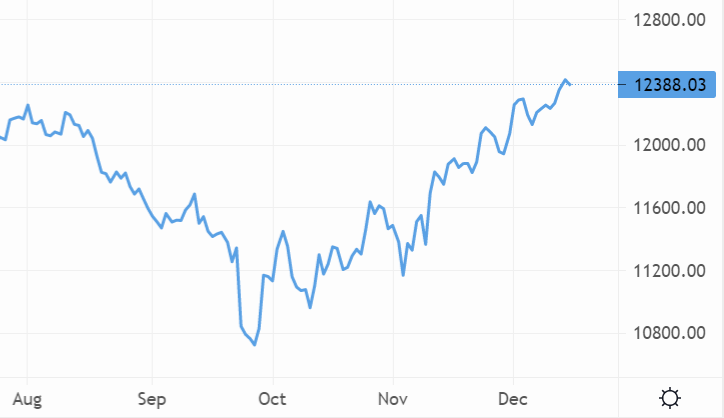
GBP/USD cuts back slightly on Thursday morning – Source: capital.com
The pound is still in a strong position against the dollar though, as the market gears up for today’s interest rate decision from the Bank of England.
A 50 bps hike in line with yesterday’s Federal Reserve announcement is more or less a given, but the real story will be in the BoE’s forward projections.
Gilt yields have come down a long way since the mini-budget armageddon, but have started rising in the past week, suggesting that the market could be pricing in rate rises on the hawkish side in 2023.
Despite Sterling’s pre-policy announcement volatility streak against the greenback (see below), the EUR/GBP trading pair remains wedded to the 86p price point.
.
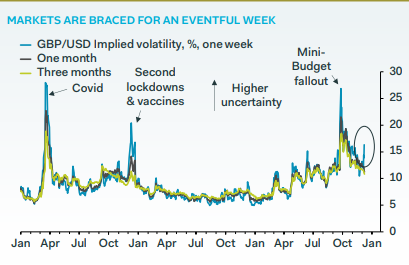
Source: Pantheon Macroeconomics
We’ll also get an interest rate decision from the European Central Bank today.
Eurozone inflation is still particularly painful, but a reversion to 50 bps following two straight bouts of jumbo hikes is largely expected.
Whether that results in a softening of the euro against the US dollar will depend on what the bank has in store for 2023. In the meantime, EUR/USD remains strong at 1.065, despite edging back around 0.2% from an intraday high of 1.068 in this morning’s Asia hours.
7.00am: Interest rate decisions take centre stage
FTSE 100 expected to open lower on Thursday after the Federal Reserve signalled more rate rises were on the way and as investors look ahead to rate calls by the Bank of England, the ECB and the Swiss National Bank today.
Spread betting companies are calling the lead index down by around 12 points.
US markets closed lower after the Federal Reserve chairman Jerome Powell signalled more data was needed before the central bank would meaningfully change its view of inflation.
At the close the Dow Jones Industrial Average was down 143 points, or 0.42%, to 33,966. the S&P 500 fell 24 points, or 0.61%, to 3,995 and the Nasdaq Composite dipped 86 points, or 0.76%, to 11,171.
“The inflation data received so far for October and November show a welcome reduction in the monthly pace of price increases. But it will take substantially more evidence to give confidence that inflation is on a sustained downward path,” Powell said.
Powell’s comments came after the Fed increased interest rates by 50bps, as expected, to a target range of 4.25% to 4.5% - the highest level since early 2008.
But in the announcement accompanying the rate rise, officials said ongoing increases "will be appropriate" in order to help bring inflation down to the Fed's target level.
Over in Asia, the Nikkei 225 index was down 0.4% in Tokyo and the Hang Seng index in Hong Kong was down 1.4% hit by the latest Chinese retail sales and industrial production numbers which paint a dire picture of the Chinese economy last month.
Back in London and the decision by the Bank of England will take centre stage.
“We could see some policymakers argue for a 25bps hike as opposed to a 50bps move, while we could also see some push for a move of 75bps in order to front load the hiking process” suggested Michael Hewson chief market analyst at CMC Markets UK.
But “the odds favour a move of 50bps in line with the Federal Reserve last night” he said.
Soon after the Bank of England announces its decision the European Central Bank will make its call and is expected to follow suit in hiking rates by 50bps.
In Thursday's corporate calendar, there are half-year results from electricals retailer Currys and a trading statement from outsourcer Serco.