
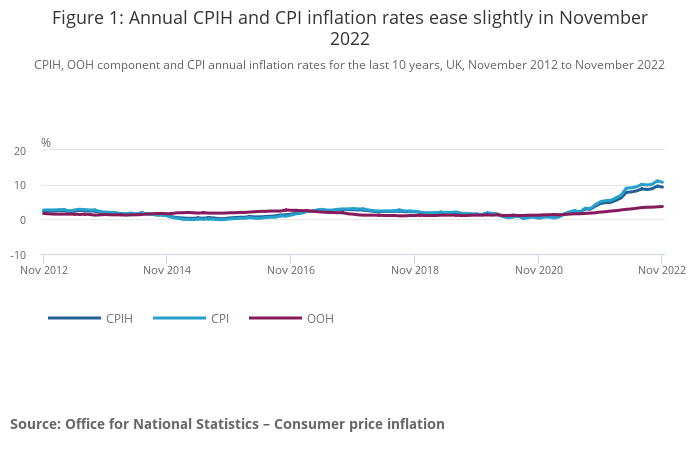
Economists forecast that UK inflation has now peaked as figures from the Office for National Statistics (ONS) showed pricing pressures eased slightly in November, falling back from October’s 41-year high.
The annual UK CPI index fell to 10.7% in November, from 11.1% in October, and lower than the 10.9% forecast by City economists as falling fuel costs offset rising prices in restaurants, cafes and pubs.
But as ONS chief economist Grant Fitzner pointed out: “Prices are still rising, but by less than this time last year.”
The ONS said there were also downward effects from tobacco, accommodation services, clothing and footwear, and games, toys and hobbies.
The annual inflation rate for transport fell for a fifth consecutive month to 7.6% in November 2022, its lowest rate since June 2021, and from a peak of 15.2% in June 2022.
The main drivers behind the easing in the rate between October and November 2022 came from motor fuels and second-hand cars.
Economists suggested inflation may now have peaked.
"Overall, inflation has passed its peak and will continue to fall from here,” according to Paul Dales, chief UK economist at Capital Economics.
He noted: “Inflation eased in six of the 12 main categories, which provides some encouragement that it is not a one-off.”
But Susannah Streeter, senior investment and markets analyst at Hargreaves Lansdown, cautioned that although inflation may have peaked “there is still a vertiginous descent to navigate before it’s back down to less dangerous levels”.
Kallum Pickering, senior economist at Berenberg, agreed that the UK inflation number which followed weak CPI figures in the US yesterday “adds to the growing evidence that price pressures have probably peaked in the Western world”.
While it is unlikely to impact the Bank’s rate call tomorrow, Pickering said the data “strengthens our call that the BoE will not hike further beyond tomorrow’s move”.
“While there is some risk that policymakers may go for one final 25bp hike at the February meeting, the case for doing so is weakening.”
Samuel Tombs, chief UK economist at Pantheon Macroeconomics, said the figures “suggests that the peak rate now lies firmly in the past” and will be a relief to the Bank of England.
“We continue to think that the headline rate of CPI inflation will fall swiftly next year, to about 8% in April and 3% by the end of the year,” he commented.