
- FTSE 100 closes down
- BT better after Nokia deal
- Housebuilders downgraded
4.43pm: FTSE closes in red
FTSE 100 closed in the red midweek as investors turned their attention to Central Bank rate setting drama.
Britain's top share index finished almost seven points lower, or 0.09%, at 7,496.
"European markets have undergone a rather subdued session ahead of tonight’s Fed rate decision, where it's widely expected we’ll see a downshift to a 50bps rate hike, as inflationary pressures subside," noted Michael Hewson, chief market analyst at CMC Markets UK.
He suggested Fed chair Jerome Powell may deliver a "hawkish" statement designed to push back on market expectations of an imminent softening of the Fed’s position, which could put pressure on stocks overnight.
"It's set to be an important 24 hours for equity markets with the Federal Reserve looking to set the tone ahead of tomorrow’s Bank of England, and European Central Bank rate meetings where we’re also expecting to see 50bps rate hikes," added Hewson.
3.37pm: Investors cautious ahead of rate decisions
Leading shares remain in the red heading into the close, as investors keep their powder dry ahead of the US Federal Reserve's interest rate decision later today, and the Bank of England's anticipated rise tomorrow.
The FTSE 100 is down 19.71 points or 0.26% at 7483.18, having earlier fallen to 7461, shrugging off the positive news of better than expected UK inflation figures.
British Airways owner International Consolidated Airlines Group SA (LSE:IAG) is the biggest faller in the leading index, down3.43% after a revenue warning from US group JetBlue Airways (NASDAQ:JBLU) on Tuesday.
Mining shares subsided on continuing concerns about the outlook for key commodity consumer China.
Anglo American PLC (LSE:AAL) has fallen 2.7%, while Rio Tinto PLC (LSE:RIO) is off 2.47%, not helped by a downgrade by JP Morgan.
The same broker moved from overweight to neutral on Taylor Wimpey PLC (LSE:TW.), helping push its shares down 1.63%.
But BT Group PLC (LSE:BT.A) added 3.16% after it submitted its new Equinox 2 wholesale fibre offer to regulator Ofcom and also announced the expansion of its partnership with Nokia in a five-year deal for the Finnish group's AVA Analytics software for fixed networks.
3.15pm: Pension funds need to learn lessons from gilt market turmoil - regulator
Pension schemes have to learn lessons following September's market turmoil in the wake of the disastrous mini-budget, the pensions regulator has said.
Some schemes used strategies involving liability-driven investment funds, but when gilt prices fell and yields soared by some 150 basis points, they faced calls for cash which left them scrambling to raise funds.
The Bank of England had to step in and guarantee to buy up to £65bn worth of gilts to stabilise the market.
Charles Counsell, the chief executive of The Pensions Regulator told the Work and Pensions Committee today: "What happened at the end of September was extraordinary movements, absolutely unprecedented movements.
"Obviously, we have asked ourselves the questions of what lessons we have got to learn from that. It is clear that the levels of collateral weren't sufficient.
"You have got to ask questions as a regulator as to how much you do push companies. Quite often we are accused of putting too much burden on our regulated community.
"Given what had happened in movements in yields historically, the movements of 100 basis points seemed plausible, but pretty unlikely. As it happened, something much worse happened."
2.42pm: US markets edge higher
US stocks inched higher at the open as traders eagerly awaited the outcome of the Fed’s December rate-setting meeting due later today.
Just after the market opened, the Dow Jones Industrial Average had added 76 points or 0.2% at 34,185 points, the S&P 500 was up 9 points or 0.2% at 4,028 points, and the Nasdaq Composite had gained 19 points or 0.2% at 11,271 points.
Forex.com market analyst Fiona Cincotta said a 50-basis point rate hike was priced, with investors more concerned over what signals policymakers could give about 2023 and when interest rate hikes could stop.
“Let’s not forget that inflation is still 3.5 times the Fed’s 2% target,” Cincotta said.
“Any signs that the Fed’s terminal rate is forecast to be over 5% would suggest that the Federal Reserve will hike interest rates for longer, which could drag stocks lower and boost the US dollar.”
She continued: “On the other hand, should the Fed downwardly revise its quarterly inflation forecast, the market could interpret this as a move towards a dovish pivot, which could lift stocks higher while pulling treasury yields and the US dollar lower.”
Back in the UK, the FTSE 100 is still in the red but off its worst levels, down just 8.07 points at 7494.82.
2.12pm: Eurozone industrial production falls
Over in Europe, industrial production in the eurozone fell sharply in October.
The energy crisis and weaker demand saw it fall by 2% from September, according to figures from Eurostat.
Euro area #IndustrialProduction -2.0% in October over September 2022, +3.4% over October 2021 https://t.co/xWW3P698xH pic.twitter.com/O7sL68YC85
— EU_Eurostat (@EU_Eurostat) December 14, 2022
The statistics agency said: "In the euro area in October 2022, compared with September 2022, production of energy fell by 3.9%, durable consumer goods by 1.9%, intermediate goods by 1.3% and capital goods by 0.6%, while production of non-durable consumer goods rose by 0.3%."
1.10pm: Underlying UK inflation still increasing - NIESR
Headline UK inflation fell from 11.1% in October to 10.7% last month, but a measure of underlying inflation was still on the way up and reached a new record.
The measure by the National Institute of Economic and Social Research, which excludes 5% of the highest and lowest price changes, rose to a new series high of 9% from 8.8% in October.
Paula Bejarano Carbo, associate economist at NIESR, said the increase showed that underlying inflation remained high and persistent: "This signals the need for the [Bank of England] to raise its policy rate further at its meeting tomorrow, despite Monday’s anaemic GDP number.”
12.30pm; Investors keen to hear Fed commentary accompanying rate decision
Markets are expecting the US Federal Reserve to raise rates by 50 basis points later, but the commentary surrounding the decision will determine how investors react.
Craig Erlam, senior market analyst at Oanda, said: "Today's announcement, forecasts, and commentary will set the scene for next year, in particular the first quarter which is still fraught with uncertainty over just how far the central bank will go.
"Policymakers have been clear this year that regaining control of inflation comes first, no matter the economic consequences. Of course, the two are linked and throughout that time, the central bank has maintained that a soft landing is possible and if recent inflation data is to be trusted, it may well be achieved.
"Yesterday's CPI data was very welcomed by the investment community, confirming once more that inflation is heading in the right direction, finally, and at a pace - much like the ascent this year - that's exceeding expectations. The rate hikes are working and given they work with a lag, the numbers in the new year should be more promising again.
"There will be an economic cost though and the stubbornness of higher wage growth could pose a risk to the Fed returning inflation to target. But the last couple of CPI reports will help settle the nerves at the Fed and attention next year may now shift more to not overtightening, creating deflation risks, and even supporting the economy.
"To what extent the central bank is willing to admit or acknowledge that will determine how markets respond today. As will the forecasts, which could heavily hint at what the policy response will be early in the new year. While markets are still pricing in another 50 basis points of hikes in the new year, following an anticipated 50 today, that could be further scaled back if the forecasts allow for it today."
11.50am: US markets await Fed decision
Wall Street is expected to open lower as traders hold back from taking positions ahead of the outcome of the two-day rate-setting meeting of the final Federal Open Market Committee (FOMC) of 2022.
Futures for the Dow Jones Industrial Average fell 0.2% in Wednesday pre-market trading, while those for the broader S&P 500 index shed 0.2% and contracts for the Nasdaq-100 declined by 0.3%.
Markets came off their best levels but still closed higher on Tuesday after softer-than-expected inflation data for November raised expectations that the Fed will contain any increase in interest rates to 50 basis points after hiking rates by 75 basis points at each of its last four meetings.
The Dow Jones ended 0.3% higher on Tuesday at 34,109, while the S&P 500 rose 0.7% to 4,020 and the Nasdaq advanced 1% to 11,257.
“Following yesterday’s downside surprise in US inflation, traders now eagerly await the FOMC later today,” said James Harte, market analyst at TickMill Group. “Initial excitement in risk markets was quickly tempered yesterday suggesting that plenty of caution still remains with regard to the Fed’s outlook.”
Harte noted that Federal Reserve chair Jerome Powell has been keen to stress a willingness to avoid abandoning rate hikes too early, something the market has also heard from several Fed members recently.
“With that in mind, the Fed seems likely to try and strike a more balanced tone, acknowledging a welcomed downturn in inflation but the need to keep hiking rates into next year in order to bring prices down sustainably,” Harte added.
Back in the UK, the FTSE 100 is down 22.32 points or 0.3% at 7480.57.
11.39am: Company insolvencies jump in November
The number of companies in England and Wales becoming insolvent jumped by 21% year on year in November as the rising costs and interest rates saw firms struggle.
According to the Insolvency Service, the number of registered insolvencies last month was 2,029 compared to 1676 a year ago.
It is also 35% higher than the number registered three years ago before the pandemic.
There were 290 compulsory liquidations in November 2022, more than 5 times as many as in November 2021 and 7% higher than in November 2019. These have increased from historical lows seen during the pandemic, partly as a result of an increase in winding-up petitions presented by HMRC.
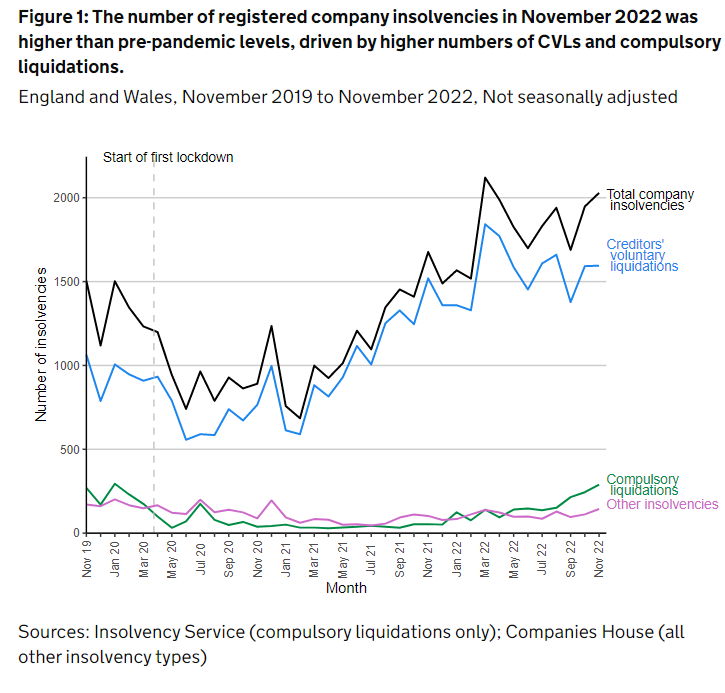
Claire Burden, Head of Advisory Consulting at professional services group Evelyn Partners said: “The year-on-year rise in the number of monthly company insolvencies can be attributed to businesses struggling to deal with post Covid debts, rising interest rates and inflationary increases failing to be passed onto already cost-wary consumers.
“We are seeing an increasing number of worried directors who are struggling to keep their businesses afloat. These are good companies but facing serious and continuing increases in energy costs, wage demands and interest rates. The vast majority of directors have never before faced these levels of inflation and are having to change their ways of working to assert more control.
“The insolvency stats remain concerning for one main reason: the sheer level of liquidations compared to ‘rescue’ insolvency procedures like administrations, where jobs are saved. This highlights that directors are leaving it far too late to take the steps needed to save jobs. This delay is not only having a wider economic impact through job losses, but also may cause a raft of claims against directors personally for failing to protect the interests of the company and its creditors."
10.57am: Crude edges higher
Oil price are heading higher, helped by continued weakness in the dollar after the better than expected US inflation figures yesterday.
Brent crude is up 0.89% at US$81.4 a barrel while West Texas Intermediate, the US benchmark, is 1.02% better at US$76.16.
Victoria Scholar, head of investment at interactive investor, said: "Oil prices are trading modestly higher with brent crude back above $80 a barrel, logging its best daily gain in over a month. Softer US inflation data prompted a depreciation in the US dollar, which has supported Brent and WTI.”
The rise has helped lift Harbour Energy PLC (LSE:HBR) by 2.8% while BP PLC (LSE:BP.) is 0.82% better. Shell PLC (LSE:SHEL, NYSE:SHEL) however has edged marginally lower.
Overall, leading shares remain in the red, with the FTSE 100 down 25.42 points or 0.34% at 7477.47.
10.15am: House prices rise in October according to official data, but that could be swansong for boom
Average UK house prices edged up just 0.3% to £296,000 in October, according to the latest government figures.
But this official report lags the most recent housing suveys from building societies which have shown a sharp drop in prices in November.
The Halifax, for example, said that prices fell by 2.3% last month, the biggest monthly drop since the beginning of the global financial crisis in 2008.
According to the Office for National Statistics report, house prices rose by 12.6% in October compared to a year ago and reached a record high.
But it said: "The increase in the annual percentage change was partly caused by a sharp fall in UK average house prices in October 2021, following changes to Stamp Duty Land Tax."
The average UK house price was £296,000 in October 2022.
This is £33,000 higher than the same period a year ago and little changed from last month.
— Office for National Statistics (ONS) (@ONS) December 14, 2022
Jonathan Hopper, chief executive of Garrington Property Finders, said: “While the official data still show that house prices inched upward in October, things have cooled sharply since then. Right now the question is where and by how much will prices fall, and whether the descent will be a soft landing or something more bumpy.
“October’s 0.3% month-on-month increase in average prices may be the swansong for the extraordinary post-pandemic boom. The momentum generated by that boom lives on in the 12.6% annual rate of price growth, which despite October’s surprise increase, has come down quickly from the 15.2% it stood at just three months ago.
“The sudden drop in buyer demand unleashed by October’s soaring mortgage rates sent shock waves through the market, shaking buyer confidence and forcing many would-be first-time buyers to shelve their dream of owning a home."
9.55am: Cost of living crisis not over - think tank
Back with the UK inflation figures, and despite the better than expected outcome for November, the cost of living crisis is set to continue, says the Resolution Foundation.
And Its senior economist Jack Leslie points out that families are still getting poorer month by month.
Sharpest fall in inflation in 16 months will be of more comfort to policy makers than families, says @jackhleslie , in response to the latest @ONS inflation data https://t.co/C5xd04eAaQ pic.twitter.com/fh51USESts
— Resolution Foundation (@resfoundation) December 14, 2022
9.25am: BT unveils new wholesale fibre offer
In a falling market, BT Group PLC (LSE:BT.A) is bucking the trend after an update on its new wholesale fibre offer.
Its shares are up 3.78%, making it the biggest riser in the leading index, as it submitted its Equinox 2 offer to regulator Ofcom.
Equinox 2 offers price discounts to incentivise broadband operators to move their customers to BT Openreach's full fibre network from the legacy copper line service.
Katie Milligan, chief commercial officer at Openreach, said: “We’re investing £15bn to upgrade the UK to ultrafast, ultra-reliable Full Fibre broadband and we’re keen to get more homes and businesses using this new network as soon as we’ve built. That way the whole country will benefit.
"To that end, we’ve responded to our customers’ desire for lower prices and long-term certainty."
BT was also boosted by news it had expanded a partnership with Nokia, agreeing a five year deal for the Finnish company's AVA Analytics software for fixed networks.
Overall though the FTSE 100 remains in the red, down 33.02 points or 0.44% at 7469.87.
Victoria Scholar, head of investment at interactive investor said: “European markets have opened lower amid cautiousness ahead of a slew of key central bank decisions from the Fed, the ECB and the Bank of England. The Federal Reserve is likely to raise rates by 50 basis points at the conclusion of its meeting this evening as the pace of tightening looks set to slow as inflationary pressures ease."
9.09am: TUI investors cautious despite company's return to profit
TUI AG (LSE:TUI), the world's largest holiday company, may have moved back into profit last year but investors remain cautious, and its shares have fallen back.
They are currently down 8.33%, making them the biggest faller in the mid-cap FTSE 250.
Sophie Lund-Yates, equity analyst at Hargreaves Lansdown, said: "For all the progress, TUI is mindful of the unforgiving economic uncertainty. A cost-of-living crisis means it’s almost impossible to map demand accurately. Sunny getaways are far from front of mind for much of TUI’s core demographic these days, and exactly what this will mean for the first quarter is yet to be seen.
"Strikes from Border Force officials is another spanner in the works, with disruption on an operational and demand level highly likely in the coming weeks.”
Richard Hunter, head of markets at interactive investor, said: "Investors will need to see evidence of an established trend before warming to the prospects of the company. In the meantime, inflation, disruptions, labour shortages and competition from lower-cost operators which could well capture the imagination of cash-starved consumers could all provide headwinds."
8.48am: Housebuilders among the fallers
Housebuilders are under pressure after broker downgrades.
With the sector affected by the recent rises in mortgage rates, analysts at JP Morgan have cut their rating on Taylor Wimpey PLC (LSE:TW.) from overweight to neutral and their price target from 170p to 110p.
The move has left the builder the biggest faller in the leading index, down 2.26% to 101.85p.
The analysts have also moved their recommendation on Redrow PLC (LSE:RDW) from neutral to underweight and their price target from 550p to 390p, leaving its shares 4.06% lower at 453.2p.
Meanwhile Barratt Developments PLC (LSE:BDEV) has also fallen back, down 1.57% as JP Morgan cut its price target from 490p to 380p.
8.38am: Inflation remains historically high
Inflation may be easing but it is still historically high, as former monetary policy committee member Andrew Sentance indicates.
UK inflation edged down - CPI to 10.7 percent (from 11.1) and RPI to 14 percent (from 14.2). But both figures are still the second highest seen since the early 1980s. Inflation remains extremely high despite the small drop.
— Andrew Sentance (@asentance) December 14, 2022
And Simon French, chief economist at Panmure Gordon, points out that whether the downward trend continues next year partly depends on what happens when the government's energy support package ends next April.
Lowest UK CPI increase since January (+0.4% MoM) takes UK CPI down to 10.7% YoY. Consistent with wider price trends that have also peaked. Recent £ appreciation also helps. CPI rate should keep falling to March - thereafter a lot hinges on govt interventions in energy markets
— Simon French (@shjfrench) December 14, 2022
8.21am: London market takes its lead from Wall Street
Leading shares are heading lower, ignoring the better than expected - although still high - UK inflation figures.
Instead the London market is taking its cue from Wall Street, which surged after the US CPI numbers also improved but came off its best levels by the close.
Shortly after the open the FTSE 100 is down 21.61 points or 0.29% at 7481.28.
Investors remain cautious ahead of today's interest rate decision from the US Federal Reserve, and the subsequent comments from chair Jerome Powell.
Michael Hewson, chief market analyst at CMC Markets UK, said: "US markets surged higher on the open with the S&P500 pushing up to 3-month highs, however there was some reluctance to follow through the initial gains ahead of today’s Fed rate decision, with US stocks eventually finishing the session well off their peaks, which in turn looks set to see markets in Europe open slightly lower.
"This caution is probably well-merited given today’s Fed decision where we are still expecting to see a 50bps rate rise, but where there is a risk that the exuberance of yesterday might not survive first contact with Fed chair Jay Powell’s press conference.
"While Powell reinforced the narrative behind a step-down in the pace of Fed rate rises in his Brookings speech earlier this month, he may well not be so keen to feed into the markets pricing in a more dovish outlook for rates as we head into 2023, especially when CPI is still very high, and when there is still a material risk that inflation could remain high deep into 2023...
"Of course, much of that will depend on what follows data wise over the next few weeks with the December payrolls report due in January followed by subsequent inflation numbers which will fall due between now and the 1st February, when the FOMC first meets next year."
8.03am: Tackling inflation is number one priority - Hunt
Chancellor Jeremy Hunt has said tackling inflation is the number one priority and making the wrong choices would prolong the pain.
Which seems to be another shot across the bow of paying public sector workers increases in line with inflation.
Inflation is plaguing economies across Europe - it’s the number one enemy that makes everyone poorer. Getting it down is my top priority
We have a plan to help halve inflation next year. But if we make the wrong choices, high prices will persist and prolong the pain for millions
— Jeremy Hunt (@Jeremy_Hunt) December 14, 2022
8.01am: GBP rallies against USD as selling pressure hits greenback, EUR continues to run hot
The US Dollar Index (DXY) is facing selling pressure following yesterday’s surprisingly soft inflation reading.
Coming in a 7.1%, year-on-year (YoY) inflation beat expectations of 7.3%, causing a rally on equities and investors weighed up the prospect of a looser economic policy from the Federal Reserve.
DXY finished the Tuesday session one percent lower at 103.59 and has remained there so far this morning.
Cable pounced on the weaker greenback, soaring to six-month highs of 1.244 before cutting back around 90 basis points before session’s close.
As of now, Cable is changing hands at 1.235, as the pound contends with its own selling pressure given that UK inflation data also came in softer than expected
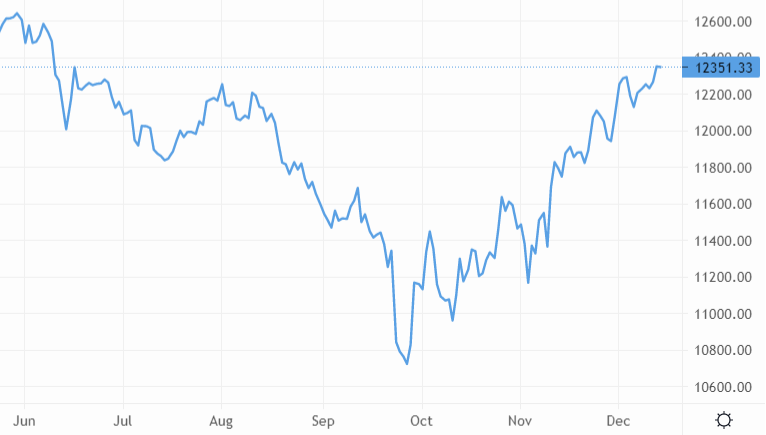
The rallying GBP/USD pair underscores greenback’s selling pressure – Source: capital.com
Today’s reading underscored a YoY rate of 10.7%, beating estimates of 10.9%, with retail prices falling sharply against the month (although by slightly less than expected).
Core inflation (which excludes food and energy from the basket) finished at 6.3% against a 6.5% forecast.
Peak inflation might be behind us, but with UK 10-year gilts dropping to their lowest price in a month (at 3.3%, yields have jumped nearly 30 basis point in the past week), the market clearly expects a degree of hawkishness from the Bank of England in the short term.
In the eurozone, where inflation remains stickier than in the US and UK, analysts are weighing up the potential for a surprise jumbo hike in today’s interest rate decision from the European Central Bank.
That would cause a rally on the euro, which is already running hot. EUR/USD closed 0.8% higher yesterday at 1.062 yesterday, prices not seen since early June.
Price action in the EUR/GBP pair is more muted, having remained in the 86p ballpark since the start of December.
7.52am: Has inflation peaked?
Core inflation - which excludes price changes in food and energy - fell from 6.5% to 6.3%.
Again this was better than expected, with analysts forecasting an unchanged outcome.
The figures give some encouragement that inflation may have peaked.
Paul Dales, chief UK economist at Capital Economics, said: "Inflation eased in six of the 12 main categories, which provides some encouragement that it is not a one-off. Petrol prices actually still rose by 0.8% m/m in November. But as that was smaller than the 5.1% m/m leap last November, petrol price inflation fell from 22.2% to 17.2%.
"The latest falls in oil and petrol prices suggest that petrol price inflation will slump in December and January. Second-hand car prices fell by 0.2% m/m in November and its inflation rate slipped from -2.7% to -5.8%. The inflation rates for clothing & footwear, recreation & culture and alcohol & tobacco all eased. Food inflation nudged up from 16.5% to 16.6% and restaurants inflation climbed from 7.8% to 9.7%. But both of those will probably fall sometime in the next three to six months as the effects of the recent falls in agricultural commodity prices are felt..
"Overall, inflation has passed its peak and will continue to fall from here. That will prompt a sigh of relief in Threadneedle Street. But with the economy still proving resilient and wage growth still strong, the Bank of England won’t be complacent. So interest rates are still going to be raised further, but the Bank will probably raise them at a slower rate and the risk is that they peak at a lower level than the 4.50% we are forecasting."
7.36am: UK inflation falls back from its 41 year high
UK inflation eased slightly in November to a better than expected 10.7% from the 41-year high of 11.1% recorded in the previous month.
This is better than the expected fall to 10.9% and comes as the Bank of England begins its latest meeting when it is likely to raise interest rates by a further 50 basis points to 3.5%.
The fall in inflation was helped by lower motor fuel prices feeding through to the overall figure.
Grant Fitzner continued: (2/2)
— Office for National Statistics (ONS) (@ONS) December 14, 2022
Susannah Streeter, senior investment and markets analyst at Hargreaves Lansdow, said: ‘’Inflation may be past the peak but given that prices for UK consumers have scaled a mountain, there is still a vertiginous descent to navigate before it’s back down to less dangerous levels.
"Lower fuel and second-hand car prices have helped bring down the headline CPI rate but price pain continues in many parts of the economy with increases in alcohol costs in pubs, cafes and restaurants particularly onerous.
"The Bank of England is still expected to raise rates by 0.5% tomorrow, increasing borrowing costs yet again for households and businesses, to try and shove away demand and push prices down. The dark clouds hovering as a recession rolls in are likely to hasten the path lower, but policymakers will still want to tread carefully, fearful that the economy could be shoved into a deep crevasse of contraction if rate rises are too steep
"It’s likely that the next moves by the Bank of England will be more moderate 0.25% hikes with an expectation of reaching 4.75% by the middle of 2023."
7.00am: Early falls expected in London
FTSE 100 expected to open slightly lower ahead of UK inflation figures and the key interest rate decision by the US Federal Reserve later in the day.
Spread betting companies are calling the lead index down by around 7 points.
US markets ended the day in positive territory, but off earlier highs, as weaker than expected inflation figures suggested pricing pressures may be on the wane.
At the close the Dow Jones Industrial Average was up 104 points, or 0.3%, to 34,109, the S&P 500 rose 29 points, or 0.74%, to 4,020 and the Nasdaq Composite advanced 113 points, or 1.01%, to 11,257.
The weak data boosted hopes that the Federal Reserve will signal a lower peak in interest rates, and a slower pace of increases, than previously forecast when it makes its latest rate call today. A rate rise of 50bp is still expected.
“We expect this will open the door for Fed Chair Powell to discuss a further step down in the pace of rate hikes at his post-FOMC meeting press conference” said Mickey Levy at Berenberg.
“Chair Powell is likely to lay the groundwork for a 25bp rate hike at the FOMC’s February meeting,” he suggested.
In Asia on Thursday, the Japanese Nikkei 225 index was up 0.7%. In China, the Shanghai Composite was down 0.2%, while the Hang Seng index in Hong Kong was up 0.6%. The S&P/ASX 200 in Sydney closed up 0.7%.
Back in London and results are due from travel company Tui while CPI figures are also set to be reported.
"On the headline CPI numbers we are expecting to see price pressures slowdown from 11.1% to 10.9%, although when inflation is well above 10%, perhaps slowdown isn't the correct term” commented CMC Market’s Michael Hewson.
“It also isn't likely to affect the calculus for the Bank of England tomorrow when they are also expected to raise rates by 50bps, although any decision is unlikely to be unanimous," he added.