
- FTSE 100 down 17 points
- LSE hit by downgrade
- BT down on pension news
4.45pm: FTSE 100 finishes lower
The FTSE 100 finished the day 17 points lower at 7,472 points for a loss of 0.2% on the day.
Looming central bank decisions could keep moves muted this week, FOREX analyst Fiona Cincotta wrote.
The Bank of England is widely expected to raise interest rates by 50 basis points next Thursday as it continues to fight double-digit inflation, Cincotta noted.
3.53pm: Footsie remains in the red
Leading shares remain in the red heading into the close, as investors worry about the prospect of recession and anticipate a series of rate rises from central banks next week.
The FTSE 100 is down 13.38 points or 0.18% at 7475.81, having earlier climbed as high as 7507.
Frasers Group PLC (LSE:FRAS) is the biggest faller, down 8.77% as the retailer warned of challenging times to come.
London Stock Exchange Group PLC (LSE:LSEG) has lost 4.51% after analysts at UBS cut their recommendation from buy to neutral.
Intermediate Capital Group (LSE:ICP) is 4.48% lower as its shares went ex-dividend, while JD Sports Fashion PLC (LSE:JD.) fell 2.1% for the same reason.
BT Group PLC (LSE:BT.A) has dropped 2.74% after the telecoms group was warned it might have to put more money into its pension fund to plug a gap caused by the chaos that followed in the wake of Liz Truss’s mini-budget.
Elsewhere British American Tobacco PLC (LSE:BATS) has lost 3.17% after its latest update, with peer Imperial Brands PLC (LSE:IMB) off 2.28%.
But miners have provided some support on hopes they will gain business as China eases its zero-COVID policy.
Rio Tinto PLC (LSE:RIO) has risen 3.17% and Fresnillo PLC (LSE:FRES) is up 3.09%.
British Airways owner International Consolidated Airlines Group SA (LSE:IAG) has climbed 1.9% after a positive note from Bank of America analysts who moved from neutral to buy.
2.58pm: Asda cuts fuel prices
With the recent falls in the oil price, motorists have been impatiently waiting for that decline to feed through to the petrol pumps.
Well now Asda has cut its petrol prices by an average of 4.5p a litre, according to the RAC, but without any fanfare.
Diesel prices have been reduced by an average of 5.5p a litre.
RAC fuel spokesman Simon Williams said: "While we're pleased one major supermarket retailer has finally started heeding our calls to pass on the enormous drop in the wholesale prices of both fuels, the fact these price cuts have been made so quietly is surely admission that they should have come much sooner.
"Asda is now charging an average of 153.5p for petrol and 176.7p for diesel which is around 2p less than its rivals.
"We urge the other three supermarkets to catch up quickly - or go even further - and give drivers some much-needed relief from high prices next time they fill up...
"Despite these reductions our analysis of wholesale data shows this should really be just the beginning as there’s easily scope for another 10p a litre to come off the current average price of both petrol and diesel."
Asda has taken an average of 4.5p off the cost of a litre of unleaded across its 320 sites in the last two days ⛽️#RACFuelWatch analysis shows there’s easily scope for another 10p a litre to come off the current average price of both petrol and diesel ????https://t.co/1YVHWooeMW
— The RAC (@TheRAC_UK) December 8, 2022
2.45pm: US markets edge higher
US stocks opened slightly higher on Thursday as investors remained wary of growing recession risks ahead of the Fed’s December rate decision next week.
Just after the market opened, the Dow Jones Industrial Average had added 115 points or 0.3% at 33,713 points, the S&P 500 was up 8 points or 0.2% at 3,942 points, and the Nasdaq Composite was up 11 points or 0.1% at 10,970 points.
Meanwhile, there have been further signs the US labor market is softening with the initial jobless claims for the week ended December 3 coming in at 230,000.
Pantheon Macroeconomics chief economist Ian Shepherdson said this measure was trending upwards, with the four-week average now standing at 230,000, the highest since early September, having jumped from a low of 206,000 in early October.
“Claims are noisy, especially from Thanksgiving through mid-January, and we expect numbers closer to 215,000 over the next couple weeks but we think the trend will be materially higher once the holiday seasonal adjustment distortions fade,” he said.
Shepherdson noted that the surge in layoff announcements recorded by Challenger (which captures publicly announced layoffs but misses quiet layoffs at smaller firms) pointed clearly to a steep increase in claims, though he noted that Challenger’s numbers were more volatile and could not be used to forecast claims in the short term.
“Short-term volatility aside, the upturn in the trend in initial claims is evidence that the labor market is softening, and it’s just a matter of time before payroll growth weakens,” he said.
Back in the UK, the FTSE 100 remains in the doldrums, down 14.47 points or 0.19% at 7474.72.
1.57pm: US jobless claims exactly as forecast
US weekly jobless claims have come in bang in line with expectations.
The number of Americans claiming unemployment benefit for the first time was 230,000 last week, up from 226,000 the previous week, itself revised up by 1,000.
Just over 1.67mln people received jobless aid during the week ended November 26, up 62,000 from the previous week and the highest figure in 10 months.
It was higher than the forecast figure of 1.61mln.
It seems very clear that the pace of gross hiring is continuing to decline. While initial jobless claims (left) have moved sideways, continuing jobless claims (right) is on the rise. Suggests that it is getting harder and taking longer for an unemployed person to find a new job pic.twitter.com/5hy8MH9Po7
— Skanda Amarnath ( Neoliberal Sellout ) (@IrvingSwisher) December 8, 2022
12.51pm: Footsie outperforms mid-cap index
Leading shares have edged marginally into the green, but the more domestically focused mid-cap index is still in negative territory.
The FTSE 100 is up 3.34 points at 7492.53, helped by a rise in mining shares.
But the FTSE 250 is down 0.16% at 18,900.1.
The fallers are a mixed bunch, with chemicals company Synthomer (LSE:SYNT) down 5.89%, IP Group PLC (LSE:IPO) off 4.38%, Sirius Real Estate Limited (LSE:SRE, JSE:SRE, OTC:SRRLF) 3.94% lower as its shares went ex-dividend and Mitchells & Butlers PLC (LSE:MAB), down 3.84% amid concerns hospitality groups could suffer Christmas party cancellations due to the rail strikes.
12.10pm: Unilever may sell US ice cream brands - report
Unilever PLC (LSE:ULVR) received an early boost following a Bloomberg report it was considering a sale of its US ice cream brands for up to US$3bn.
Its shares climbed as high as 4226p before slipping back, and are now down 0.23% at 4151.5p.
Michael Hewson, chief market analyst at CMC Markets UK, said the turnaround happened when it became clear any sale would probably not include the Ben & Jerry's brand.
He said: "This is disappointing given that we’ve already seen that Unilever has already sold its Ben & Jerry’s business interests in Israel, so doing the same elsewhere would be a natural next step.
"The reality is that the Ben & Jerry’s approach and its political activism jars against the more conservative approach of Unilever management. It’s also not clear what Ben & Jerry’s brand adds to the Unilever ice cream offering. At their most recent trading update it was notable that ice cream sales were strong and that sales of its Magnum and Cornetto brands were driving those sales
"In short Ben & Jerry’s offers management nothing but headaches, as well as potentially divisive PR, while offering very little to the bottom line."
Overall the FTSE 100 remains rather aimless, down 6.34 points at 7482.85.
11.45am: US markets expected to open flat
Wall Street is expected to open where it left off yesterday as markets takes a breather from recent volatility amid little news ahead of next week’s consumer inflation data and the final meeting of the year of the Federal Reserve’s Open Market Committee.
Futures for the Dow Jones Industrial Average rose just 3 points, or 0.01%, in Thursday pre-market trading, while those for the broader S&P 500 index added 0.1% and the Nasdaq gained 0.2%.
Stocks ended flat yesterday, with the Dow gaining just 1 point to 33,597, while the S&P 500 fell, for a fifth consecutive day, by 7 points, or 0.2%, to 3,934 and the Nasdaq Composite dipped 56 points, or 0.5%, 10,959.
“Wall Street made little progress during Wednesday’s session and futures suggest we’ll see little change at today’s open,” commented James Hughes, chief market analyst at Scope Markets.
"There has been limited economic data in play this week, but yesterday’s marked decline in US mortgage applications served up another stark reminder that the Fed’s policy tightening exercise is having an impact. That in turn is going to be adding to concerns that the US could see a broader economic slump as we move into 2023."
11.30am: Precious metal miners lifted by recent gold price strength
Gold has been wanted in recent days, both for its safe haven qualities and because of dollar weakness.
And despite dipping back 0.18% today to US$1784 an ounce, analysts believe that the precious metal will continue to be in demand.
Ipek Ozkardeskaya, senior analyst at Swissquote Bank, said: "Russian President Vladimir Putin said that the nuclear threat is rising and didn’t say he wouldn’t use a nuclear weapon to defend itself, giving a fresh boost to geopolitical tensions.
"Gold may have benefited from rising safe haven flows – although the US dollar remains the ultimate safe haven if you fear a further escalation of military tensions with Russia.
"What also made gold and silver shine yesterday – besides from the softer US dollar - was news that China increased its bullion reserves for the first time in three years, in an effort to diversify away from the US dollar.
"The price of an ounce rebounded to US$1790. In this short run, gold bulls will likely see further resistance above the 200-day moving average, and the US$1800 psychological resistance. But the weakening US dollar outlook strengthens appetite for gold in the medium run. There is potential for around $100 rise to $1880, May peak."
With all that, precious metal miners are on the way up.
Fresnillo PLC (LSE:FRES) has added 2.42% and Endeavour Mining PLC (LSE:EDV, TSX:EDV, OTCQX:EDVMF) has added 0.94%.
Overall though the FTSE 100 has drifted lower again, down 10.8 points or 0.14% to 7478.39.
Michael Hewson, chief market analyst at CMC Markets UK, said: "European markets have got off to a slow start to the day, with a rebound in oil prices giving the energy sector a modest lift, while bond yields have rebounded off the lows of yesterday.
"The main focus of attention continues to be on next week’s central bank meetings of the Federal Reserve, ECB and Bank of England, and guidance on the likely glide path for rates heading into 2023."

10.42am: Price of gas heads higher
As temperatures drop, gas prices are rising.
Wholesale European prices rose by more than 5% to €159 per megawatt hour - the highest since October - before easing to €153, still up 2.52%. UK gas prices have jumped 8%.
AJ Bell investment director Russ Mould said: “Gas prices have hit their highest levels in two months as wintry temperatures hit Europe. In reality the respite provided by a mild autumn was set up to be short-lived. Relatively limited European storage capacity meant there was always a risk of the continent moving from feast to famine when it comes to gas supplies."
Susannah Streeter at Hargreaves Lansdown said: "The super-cold snap has already pushed up gas prices, as demand is expected to surge over the coming weeks. UK gas prices are up 8% edging back up from six-month lows. European gas prices also crept up by 5%, and although storage levels have inched back down, they are still above 90%.
"These higher than expected levels have boosted hopes the region will avoid an energy security crisis this winter, but governments will still be keeping a close watch on demand and the flow of LNG imports, to ensure supplies last particularly if the freeze takes hold."
10.15am: Analyst note moves airline shares
A couple of airlines are flying high after broker upgrades.
British Airways owner International Consolidated Airlines Group SA (LSE:IAG) is up 1.52% to 134.8p after Bank of America analysts raised their recommendation from neutral to buy and their price target from 140p to 200p.
The bank lifted its recommendation for Wizz Air Holdings PLC (AIM:WIZZ) in the same way, and lifted its price target from 1860p to 3200p, prompting a 3.06% rise in the shares to 2350p.
But easyJet PLC (LSE:EZJ) was not so lucky. Its shares are down 0.84% to 376.13p after Bank of America moved from buy to underperform and cut its price target from 450p to 340p.
Overall the FTSE 100 is still drifting around last night's closing level, up just 2.23 points at 7491.42.
9.35am: CBI calls for government's energy support plan for businesses to continue
Many companies could face collapse if the government removes its energy support package for businesses next April, the CBI has warned.
A CBI survey showed that companies expect their average energy costs to rise by more than 150% if the subsidies are withdrawn.
It said car and food manufacturers and intensive users such as steel makers should receive continued support beyond the spring.
Matthew Fell, CBI chief policy director, said companies accepted that blanket support was too expensive to go on indefinitely but targeted support needed to continue.
He said "There are no easy answers in all this, but the government will have to keep supporting the most vulnerable firms to help them stay competitive, to build resilience and in some cases to avoid collapse."
9.07am: China reopening hopes provide support for market
The prospect of China reopening its economy after adjusting its zero-COVID policy appear to be outweighing concerns about its growth prospect.
Insurer Prudential PLC (LSE:PRU) is up 1.9% on hopes for a boost to its business in the country while mining groups - which are big suppliers to China - are also providing some support to the market for the same reason.
Rio Tinto PLC (LSE:RIO) has risen 1.6% and Antofagasta PLC (LSE:ANTO) has added 1.13%.
Oil is up slightly after its recent falls, with Brent crude 0.82% better at US$77.8 a barrel, helping push BP PLC (LSE:BP.) up 1.28%.
8.42am: Frasers falls despite jump in half year profits
Frasers Group PLC (LSE:FRAS) is the biggest faller in the leading index so far.
Its shares are down 3.35% despite the company - whose brands now range from Sports Direct to Flannels and Gieves & Hawkes - reporting a 39% rise in half year profits, albeit boosted by acquisitions.
It also says it is confident in its guidance for adjusted pretax profit of between £450mln to £500mln.
But caution over the outlook has hit the shares.
Susannah Streeter, senior investment and markets analyst at Hargreaves Lansdown, said: "The company admits that challenges lie ahead and so it will be hard to predict what 2023 will bring. This note of uncertainty knocked its share price in early trade this morning."
Analyst Nick Bubb says the most eye-catching announcement is a plan to build a new distribution centre in Coventry, following news it has also bought the Coventry Building Society Arena where it is now in dispute with Coventry City football club which plays there.
Bubb said: "it’s unclear what’s going to happen to the huge Sports Direct warehouse and office at Shirebrook in the North Midlands, but, as rumoured, Frasers has announced that it is to build a huge new distribution complex at Coventry, at an eye-catching cost of £600mln."
Elsewhere London Stock Exchange Group PLC (LSE:LSEG) is down 2.84% at 7664p after analysts at UBS moved their recommendation from buy to neutral and cut their price target from 9000p to 8500p.
They said: "We are lowering our 2023-25 earnings per share estimates by 5-6% largely to reflect the recent weakening of the US$...
"We think the upcoming share overhang will weigh on LSEG's share price as Blackstone & Thomson Reuters (NYSE:TRI) c35% stake in LSEG is unlocked over 2023-25."
Intermediate Capital Group (LSE:ICP) has lost 1.93% after its shares went ex-dividend, while telecoms companies are also lower, with Vodafone Group PLC (LSE:VOD) off1.76% and BT Group PLC (LSE:BT.A) dropping 1.75%.
Despite all that, the FTSE 100 has edged into positive territory, up 2.98 points at 7492.17.
8.15am: Markets struggle in early trading
Leading shares remain in a holding pattern as investors await next week's key interest rate decisions from the US Federal Reserve, the Bank of England and the European Central Bank.
"Interest rate hikes might cool inflation, but the reality is they’ll also cool just about everything else." said Danni Hewson, AJ Bell financial analyst. "The question that’s been circling investors’ minds is how hard will the landing be and how long will it take for economies to get back on their feet?”
With no straight answer to that question, the FTSE 100 has dipped 6.96 points to 7482.23 in early trading , with investors also unsettled by the prospect of a winter of discontent in the UK as hundreds of thousands of workers plan to go on strike.
Among the companies reporting, British American Tobacco PLC (LSE:BATS) is down 1.9% on profit taking after recent gains.
Richard Hunter, head of markets at interactive investor, said: "Recent market volatility and the rotation away from growth stocks into value has refocussed attention on the likes of the oil and tobacco stocks.
"However unfashionable they may be, propelled by strong cash generation, inelastic demand and generous dividend yields, the likes of British American Tobacco are having their own day in the sun..Indeed, the share price has spiked by 29% over the last year, as compared to a rise of 2% for the wider FTSE100,"
Balfour Beatty plc (LSE:BBY) is 2.8% better after the infrastructure group said profit for the year was now expected to be ahead of market expectations.
And it was a similar story for packaging group DS Smith PLC (LSE:SMDS), up 0.57% as it lifted its full year guidance in the wake of an 82% leap in interim pretax profits to £322mln.
7.45am: Sterling does an about-face on the US dollar but dips against euro
Despite looking weak in the earlier hours, Cable did an about-face in yesterday’s session and ended the day 0.6% higher at 1.220.
It was unsurprising given the general direction the greenback is headed (down, that is), and indicatively, the US Dollar Index (DXY) opened this morning’s session 0.3% lower at 104.84.
In this morning’s Asia trading window, the GBP/USD pair has inched higher to 1.221, and there is little on the economic calendar to suggest any catalyst for dramatic price action today.
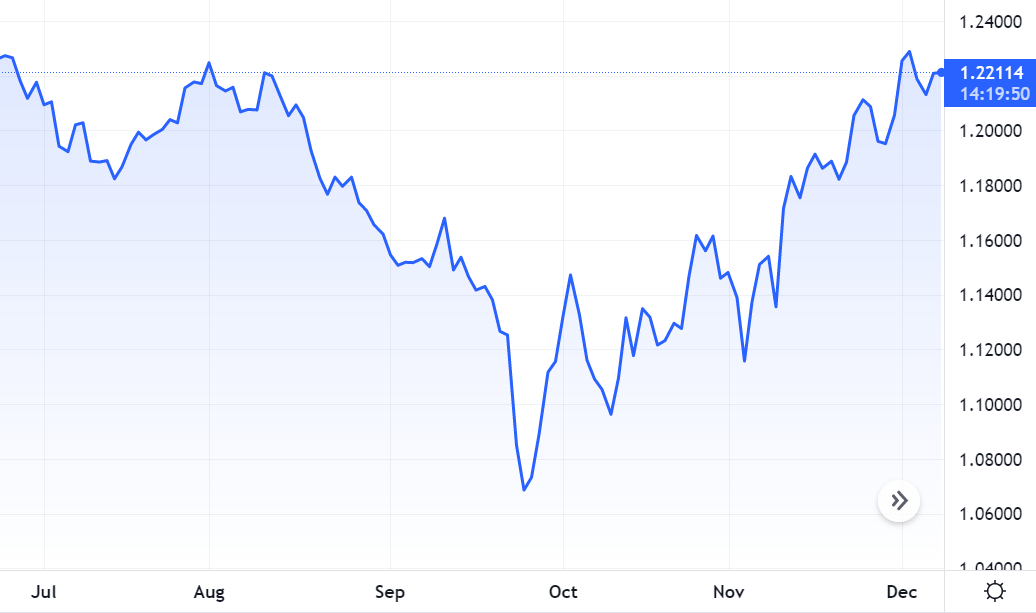
GBP/USD is generally bearish as speculation of dollar top mounts – Source: tradingview.com
USD/CAD, which was on a bit of a rally leading up to the Bank of Canada’s Wednesday interest rate decision, fell back to an intraday day low of 1.358 when the bank opted for a 50 bps hike over the softer 25 bps option.
The pair is changing hands slightly lower at 1.356 in today’s Asia session.
Yesterday’s Eurozone GDP figures came in slightly higher than expected, with third-quarter growth of 0.3% beating out 0.2% forecasts.
The most vigorous growth, of 2.3%, was recorded in Ireland, with Malta and Cyprus expanding at 1.3%, while the steepest declines were in Estonia, Latvia and Slovenia.
In response, EUR/USD closed Wednesday 0.4% higher at 1.051 and has held onto that price point this morning.
While the euro closed lower against the pound, the EUR/GBP pair has so far gained 0.12% in today’s Asia trading session and is currently changing hands at 86.19p.
7.00am: Footsie seen slightly higher
FTSE 100 seen opening slightly higher on Thursday, supported by gains in Hong Kong, but the mood may remain subdued as growth worries continue to hit sentiment.
Spread betting companies are calling the lead index up by around 8 points.
Michael Hewson chief market analyst at CMC Markets UK said: “There appears to be little in the way of significant direction in markets at the moment, hardly surprising given next week’s looming central bank decisions, and we will probably continue to see further scratchiness in the upcoming days.”
In the US, markets ended a more subdued trading session little changed pausing for breath after the recent volatility as investors look ahead to next week’s FOMC meeting.
At the close the Dow Jones Industrial Average was up 1 point at 33,597, the S&P 500 fell, for a fifth consecutive day, by 7 points, or 0.2%, to 3,934 while the Nasdaq Composite dipped 56 points, or 0.5%, 10,959.
“The market’s kind of bobbing and weaving and finding its breath after the big rally off the October lows,” Ryan Detrick, chief market strategist at the Carson Group told CNBC.
In Asia on Thursday, the Japanese Nikkei 225 index was down 0.4%, the Shanghai Composite was down 0.1%, while the Hang Seng index in Hong Kong was up 3.0%.
Back in London and trading statements are expected from construction firm Balfour Beatty and cigarette maker British American Tobacco, while there will also be half-year results from packaging firm DS Smith, online estate agent Purplebricks, and retailer Frasers Group for investors to digest.