
The ASX was mostly flat this week, gaining just +0.63% over the last five days having shed -0.55% just today.
The Hang Seng has slowly reversed its downward momentum, gaining steadily over the month (+18.04%) and rising +6.31% this week, although still down -21.47% for the year.
Indeed, the Nikkei225 was the only exchange to fall this week, shedding -2.09%. The other exchanges gained modestly in comparison, the S&P500 up +1.22%, the FTSE100 up +1.23%, and the Nasdaq +1.75%.
ASX sectors were a mixed bag; Materials (+4.12%), Info Tech (+2.08%), Comm Services (+1.66%) and Healthcare (+0.79%) all gained, while the other sectors fell, none more so than Energy (-2.58%).
Commodities on the other hand were up across the board, especially silver (+5.40%), West Texas Intermediate (+5.11%) platinum (+4.90%) and copper (+4.72%).
What made the news this week
64% of Australians are being underpaid
Almost two in three (64%) Australian workers are experiencing underpayment issues, according to new data from HR and payroll provider ADP – up from one in two just 12 months prior.
ADP’s annual survey revealed 11% or one in nine workers are ‘always’ underpaid by their employers, with that number having doubled in the last year alone.
Apart from pay being withheld, more than half (57%) of workers experienced more indirect issues with wages, specifically failed payments or incorrect tax codes.
These pay issues were exacerbated by employers’ reluctance to resolve problems quickly; some 61% of workers said their pay issues were unresolved by the next pay cycle, a particularly concerning statistic considering more than half of Australians live paycheque-to-paycheque.
“At a time when inflation and the cost of living is at an all-time high, more and more Aussie workers are finding it difficult to pay their rent, bills, and basic necessities,” Legal director ANZ at ADP Irina Shainsky said.
“It is more important than ever that employees are closely reviewing their pay and having conversations with their employers if issues arise. Employers have a responsibility to ensure they have the right systems in place to address payment issues.”
Late payments can create a negative reputation and staff retention issues, says Shainsky, on top of the potential to create cashflow and balancing problems. She recommends outsourcing to payroll services.
“Higher inflation impacts consumers and businesses alike,” she said, “Organisations are struggling with higher inflation and increased costs across the board.
“As a global recession looms, their commercial success will depend on their ability to track and review business expenses as early, efficiently, and accurately as possible.
“With States starting to legislate against wage theft, the focus has increasingly shifted to businesses’ legal obligations when it comes to correct payments. Employers must be aware of all relevant legislation to ensure they are compliant.”
US Federal Reserve to slow rate hikes
Matt Simpson, Senior Market Analyst for City Index, sheds some light on recent comments by US chair of the Federal Reserve, Jerome Powell, who recently flagged a slowdown in the pace of monetary tightening.
OK Fed followers: When is a pivot, not a pivot?
Jerome Powell hit the wires and effectively confirmed that the Fed will slow their pace of tightening, reigniting the argument over what a ‘pivot’ is.
Jereme Powell effectively confirmed that the Fed will slow their pace of tightening, prompting strong correlations among asset classes which sent the dollar and yields lower, equities, commodities and (of course) commodity FX higher.
Strong, highly correlated reactions signify important events as investors have likely been forced out of an incorrect trade, switched positions or added to their previous convictions.
And make no mistake, Jerome’s speech was an important event; if the Fed are deemed to be slowing their tightening pace, it is then assumed they are closer to pausing and eventually reversing hikes (policy blunders out with).
In turn, this has seen headlines of the famous ‘Fed pivot’ return, alongside fierce social media debates over its very definition.
Monetary policy and pivots
When it comes to monetary policy, the definition ‘pivot’ has become obscured. Personally, I view a pivot as the point in which a direction is reversed.
If I am driving north but want to head south, a pivot is the point in which the reversal of direction occurs. Using this definition for a monetary policy pivot, it would assume a Fed pivot is when they signal they are to begin cutting rates, after a series of hikes.
Yet the media feedback loop seems to have obscured this classic definition, prompting many to call a Fed pivot – despite them also saying rates will continue to rise.
Using this definition is saying a pivot is a change of momentum, not direction. To use the car analogy, a person is driving north and slows down for a bump in the road – and the point of deceleration is deemed to be the pivot.
Direction vs speed
You can argue that it doesn’t really matter, supposing one plans the trade and trades the plan. But understanding that the debate is really about whether we are measuring the change of direction verses change of momentum can quickly help you understand which ‘group’ of pivot speakers you are dealing with, and decide for yourself which is the more significant.
But the fact we saw a strong reaction in US markets which has seen little follow-through in the Asian session suggests some are already question how much of a ‘pivot’ that really was. Besides, we also have the Nonfarm payrolls report tomorrow which can also suppress volatility ahead of it.
Now and Next for the Fed
Debates aside, what most agree on is that the Fed will continue to hike rates but at a slower speed. So, it will be a case of deciphering how high they will go and how long they will remain elevated.
Fed fund futures currently estimate a 75.8% probability of a 50 basis point (bp) hike in December (from 4.0% to 4.5%)
They also assume rates to peak at 5.25% in June
However, the June peak is only a 37.3% probability so markets lack some conviction this far out
In September, the Fed’s median view was for rates to peak at 4.6% by the end of 2023 and fall back to 3.9% by the end of 2024.
It is worth noting that Powell said the terminal rate would likely be “somewhat higher than 4.6%”, so the Dot plot could be upgraded in their December meeting.
Powell warned that rates would need to be held at a “restrictive level for some time” (higher rates for longer).
With Powell warning of higher rates for longer, the money markets estimate of a peak in June may be misplaced.
The Fed next meets on 14 December, then return on 1 February.
CPI data is released 1-day ahead of the next Fed meeting which be as important as the meeting itself.
USD/JPY 4-hour chart:
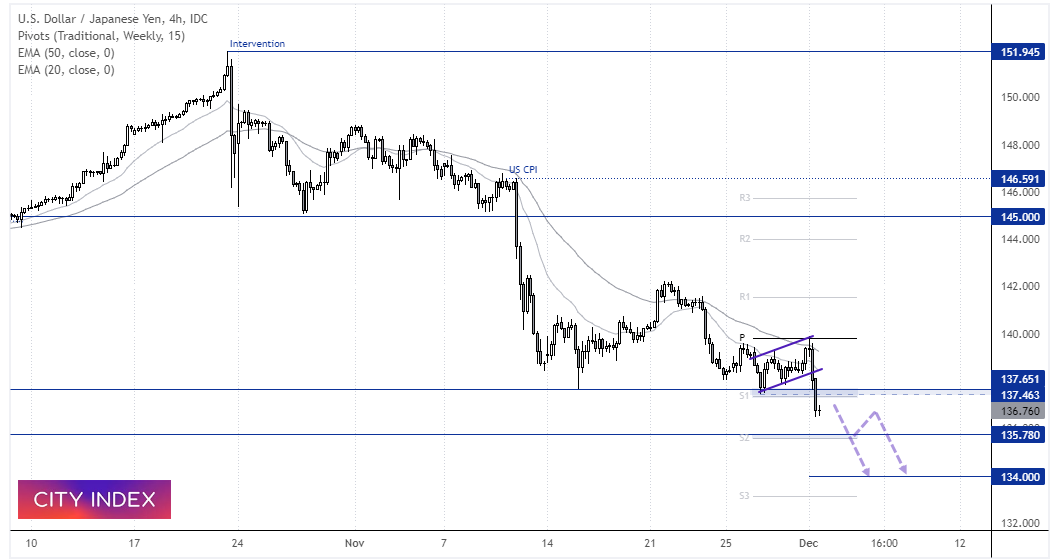
The broadly weaker US dollar sent USD/JPY below 137.46 support and invalidated the double bottom pattern.
The bearish trend from the ‘intervention’ high remains very much in play, with its recent swing high finding resistance at the weekly pivot point and 50-bar EMA.
The bias is for a move down to 134, although 135.78 makes a likely interim support level. The bias remains bearish below 138.15.
AUD/USD 4-hour chart:
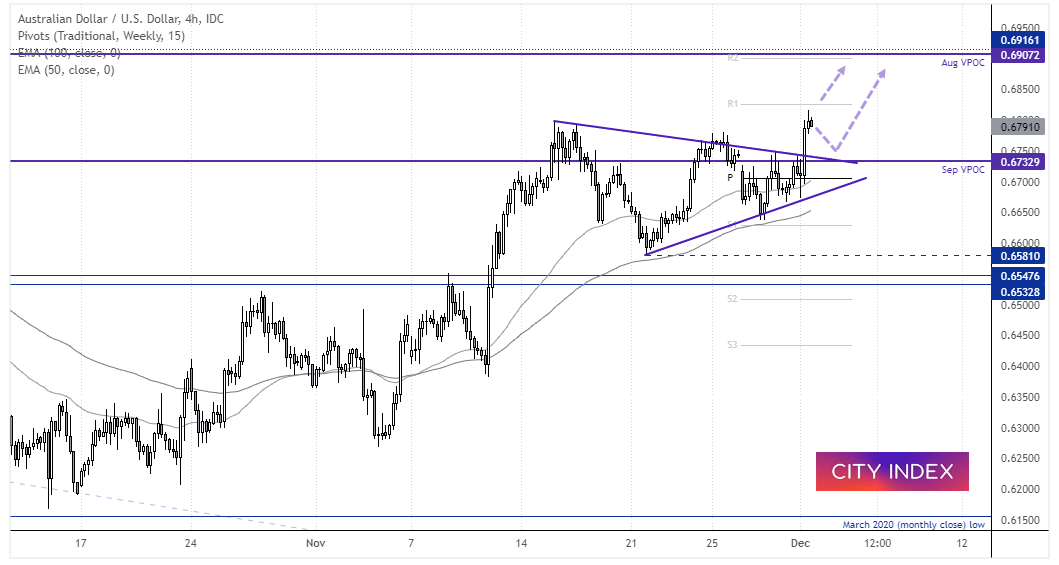
The Aussie has broken out of a symmetrical triangle to the upside, in line with its 4-hour bullish trend. The pattern projects a target around 0.6900 which is also near the August VPOC – volume point of control – which can act as a magnet for prices.
As the rally has stalled just below the weekly R1 pivot, we’d like to see a period of consolidation or retracement before reconsidering longs. And would seek dips down to 0.6750 for an anticipated move towards 0.6900.
Small cap wins for the week
Southern Gold shares soar 22.72%
Southern Gold Ltd (ASX:SAU) shares lifted 22.72% over the week after the company kicked off geophysical surveys at its South Korean projects ahead of drilling planned for early next year.
Way2VAT share price lifts 17.24%
Way2VAT Ltd (ASX:W2V) shares lifted 17.24% after the company finished the year out in a strong position, recording an annualised gross transaction volume run rate of $A19.47 million.
Latin Resources shares jump 16.66%
Latin Resources Ltd (ASX:LRS) enjoyed a jump to its share price on news the company had bumped the kaolin resource at its Cloud Nine project up by 33% for 280 million tonnes of kaolinised granite.
Predictive Discovery lifts 12.82%
Predictive Discovery Ltd (ASX:PDI) shares were up 12.82% this week, following the identification of seven priority gold targets at the company’s Bankan Gold Project in Guinea.
Chase Mining Corporation up 12.5%
Chase Mining Corporation Ltd (ASX:CML) enjoyed a 12.5% bump to its share price after it was revealed the recently acquired McIntosh Graphite Project has high potential to produce battery anode-grade material for electric vehicles.